
The Personal Neutral Archive
One place that holds every piece of your life's information — medical records, device readings, receipts, the things you notice about yourself — as plain files you own, on storage you choose. KISOP is built around this place.
Your life is made of many pieces. You assemble them your way.
This drawing shows the idea the archive is built to serve: health, family, money, work, home, learning — every piece of a life makes information, and the pieces assemble around you.
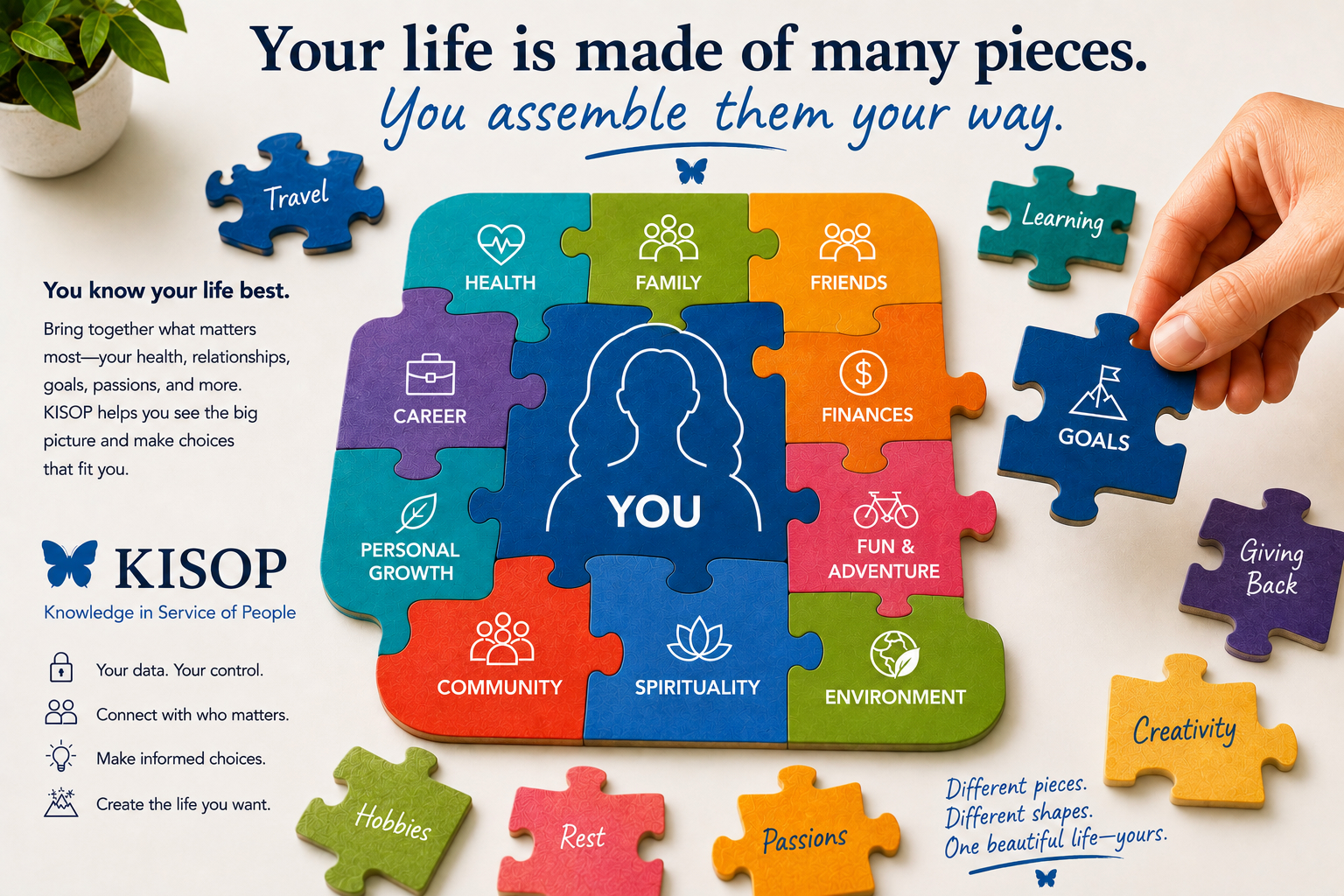
The KISOP life puzzle. The drawing moved here from the home page on August 19, 2026 — this is the page it was always about.
Why one archive
The pieces scatter. Lab results sit in one portal, device readings in an app, receipts in a drawer, a parent's care file across three inboxes. Each keeper shows you a slice. The rest stays with them.
The Personal Neutral Archive (PNA) is the place where your copies come back together. Getting the copies is a legal right in the United States and in many other places. Keeping them together, in a form no company controls, is what the archive is for.
What it is
Ordinary folders and files, on storage you control. An original goes in exactly as it arrived and is never retyped over. Beside it, a plain note records where it came from and when.
A small, free catalog reads those files and answers questions about them on your own computer. Nothing is sent anywhere. The catalog can be deleted and rebuilt from the files at any time, so losing it costs nothing.
One real archive runs this way today. What we built tells its story with a grocery receipt. A technical page shows builders the same machine with the covers off.
The archive is the foundation, not the whole system
The archive keeps your information. Other parts of KISOP govern what can be read and help you coordinate with other people without handing them the archive.
Consent Gate
Controls and records requests to read information from your archive. It answers: who asked, what did they ask for, and did your rules allow it?
Together Protocol
Helps separate archives propose, answer, and record shared plans while each person keeps private information at home.
These jobs remain separate on purpose. The Consent Gate governs reading from an archive. Together exchanges only the chosen messages needed to coordinate.
Why we call it neutral
Neutral has five specific meanings in the archive's name.
Vendor-neutral
No company's product is required to read it. Leaving any tool loses nothing.
Format-neutral
Originals stay as they arrived: a scan, a photo, a spreadsheet, a hospital export. Nothing is forced into one master shape. The archive preserves at write time and interprets at read time.
Model-neutral
Any AI you trust can be granted scoped, logged access. The most sensitive sections can be limited to models that run on your own machine. Models come and go. Every successor inherits the full richness.
Environment-neutral
Phone, laptop, home server, a cloud you choose — the archive is a folder tree. It copies, syncs, and replicates anywhere, with no installation step.
Purpose-neutral
Health is the first case, but it also depends on housing, food, work, and money. One archive can hold separate sections with different sensitivity levels.
The one rule
Anything derived from the archive — a search index, a summary, a timeline — can be rebuilt from the files at any time. The files can be rebuilt from nothing else. A system that breaks this rule is a product with your data in it. A system that honors it is your archive, with products attached.
The unplug test checks the rule on every version: turn the software off, delete the catalog, open the folders. Every record still opens and makes sense. What we built walks the test step by step.
Where it lives
Where the archive lives is your election. A folder of paper, a laptop, a home server, a cloud account you pay for — every rung is legitimate. You can move between rungs as your life changes. The archive is files. Files move.
The same archive answers to the laws of each place its owner lives. Your records live where you live tells that story, country by country.
Where this stands
One real archive exists. It has held the founder's own records, on her own computer, since July 8, 2026, watched by automated checks on every change. It passed the unplug test the night it was built and passes it on every change since.
Every access is asked and logged. A consent gate checks each request against your standing permissions and writes the request down. The gate is built and tested on the home machine. Connecting it over a network is future work.
There is no product to download yet. The pieces around the archive are being built in the open. The build log — the site's single status inventory — says what is built, what is tested, and what has not happened, dates and all.
What you can do right now: start your archive the paper-and-folders way with the free starter kit. The kit uses the same shelf design, so when the software reaches you, your shelf is already right.